
A few 2025 Standouts
Superparents

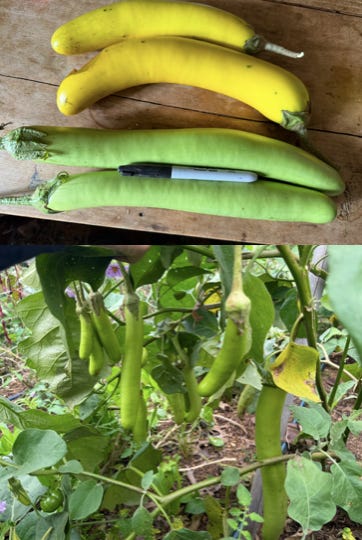
F1 interspecific eggplant hybrid “Iron String”
In the 2025 season, three crop breeding projects progressed well. One of them also produced a lot of food. I’ll start with that one: eggplant.
The Iron String
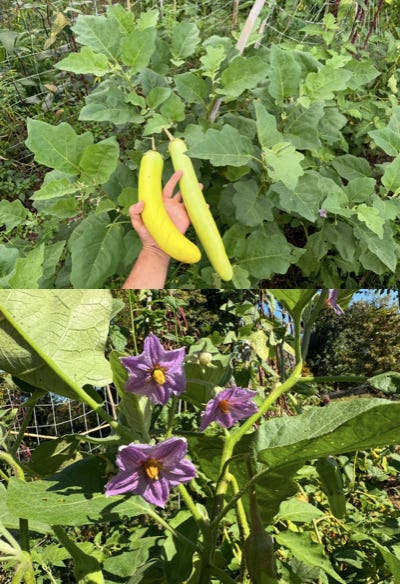
At a get together a few years ago, someone heard I was into gardening, and began talking with me about how they have good success with certain crops like tomato, but one crop they repeatedly failed with was eggplant. At that point I had never tried to grow eggplant, and wanted to know why this was the case. When I asked my uncle he said the same thing, he grows big healthy tomatoes but eggplants never did well in his patch, only making a couple small, spindly fruits. His friend however, grows a fabulous eggplant crop, just like some of the local producers here do also. The thing is, eggplants here demand pampered conditions of high fertility and continual flea beetle treatments. The result in average conditions is stunted, pitiful plants with hardly an eggplant to be harvested. Later on, I came upon an excellent cultivar of the lesser-known eggplant species Solanum aethiopicum. Solanum aethiopicum is sometimes called Ethiopian eggplant or African eggplant. Farmacie Isolde has a great selection of seeds, including Solanum aethiopicum “sweet white”. Many cultivars of S. aethiopicum are bitter, but “sweet white” is not, with a similar flavor to Asian eggplants and a bit firmer texture. Growing African eggplant side by side with Asian eggplant (S. melongena) is a night and day difference— the African eggplant is a much more vigorous and productive crop. Cooler weather doesn’t stunt its growth and neither do flea beetles. In average garden conditions with no amendments it excels. These are the types of traits you want in a crop. In 2024 I planted S. aethiopicum “sweet white” next to an Asian eggplant with wonderful culinary qualities called “Chinese string”. Chinese string produces long, thin, tender and tasty eggplants that are even good raw. As I was evaluating both of these eggplant species, the obvious thing to do was attempt to combine the larger, elongated fruit of the S. melongena “Chinese string” with the general toughness of S. aethiopicum “sweet white.” Both cultivars taste great already. Through this route, a multi-species landrace with hybrid vigor could be developed. I had read in an eggplant hybridization study that in order to recover fertility from hybrids of these two species, the African eggplant must be the maternal parent of the F1 (and then the pollen parent of the back cross). In 2024, I simply took some pollen from the stunted 2 feet tall “Chinese string” plant and placed it onto the stigma of the “sweet white” African eggplant. I had intended to do controlled pollination, which entails bagging and emasculating the African eggplant flowers the night before they open, but never got around to it. It was sort of surprising in the summer 2025 when about half the seed saved from the S. aethiopicum turned out to be interspecific hybrids. Their leaves looked a bit different, many of them had even more vigor than S. aethiopicum, and their flowers were large and purple instead of small and white like “sweet white”. In about half a dozen hybrids, several were sterile and formed zero or just 1-2 eggplants. One seedling was a clear standout, growing almost 2m (6 feet), yielding dozens of long green eggplants, and able to self-support the fruit load without staking. This single plant was astounding in its production, the photos don’t do justice to the absurd quantity of eggplants it made (must've been around 100). For a couple months I’ve been enjoying a delicious Mediterranean pickled eggplant recipe made from it. The outstanding food production was even more noticeable in 2025 due to the daily rain in the first part of the summer lasting 6 weeks. The distant cousins of the eggplants, the tomatoes (including different multi-species hybrids), were weakened by fungal disease were produced no tomatoes during this time. The eggplants thrived however. The S. aethiopicum x melongena hybrids had sterile pollen as expected, but they accepted the aethiopicum “sweet white” pollen. According to an eggplant hybridization study, crossing the F1s back to S. aethiopicum is the only way to restore full fertility to these hybrids. Next year I plan on only growing these back crossed seedlings (75% sweet white / 25% Chinese string), along with the one super vigorous and productive F1 plant grown from cuttings. I am calling this nascent interspecific eggplant landrace “Iron String.”
Passionfruit hybrids
Passiflora crossing was the first crop breeding project I got into. I’ve done a bit of selection of multi-species hybrids for cold hardiness and fruit qualities. It’s a fun genus to work with, beautiful and resilient. Last year I grew a P. incanata x edulis F1 called “Grape Soda Pop” from Dawn in North Carolina. This hybrid has some special traits: it’s able to self-pollinate and has very fertile pollen (especially for an F1). The seeds collected and grown out from Grape Soda Pop in 2025 revealed a mix of outcrosses and self-pollinations. This is the first time I have seen F2s of Passiflora interspecies hybrids. F2 production is primarily hindered by lack of self-incompatibility and by F1 pollen sterility. The outcrossed seedlings from Grape Soda Pop, a blend of 4 species (incarnata, flavicarpa, edulis, and cincinnata), revealed something amazing: some fully fertile seedlings with the ability to self-pollinate. The implication is that the biggest barrier to selecting distant hybrid passionfruits—partially hollow fruit— can be relatively easily overcome using the self-compatible trait from P. edulis. Amazingly, the self-compatibility trait also appears to be able to restore fertility when crossed into other hybrids. There is a phenomenon in some genera where the maternal traits are sometimes actually transmitted through the pollen parent during the initial interspecies hybridization event. Crossing within a species is straightforward: maternal traits are maternal and paternal are paternal. However the disturbance of interspecific hybridization can sometimes flip the script and transfer cytoplasmic traits via pollen instead of seed. Passiflora is one such genus. Therefore, if you want to do Passiflora distant hybridization, I would highly recommend using a self-pollinating P. edulis as the pollen parent to make the initial hybrids. Then you can use the resultant hybrids as seed or pollen parents to transmit self-compatibility and restore fertility to other hybrids. This is essentially a cheat code to speed up and broaden the genetic distance of interspecific passion fruit crossing.
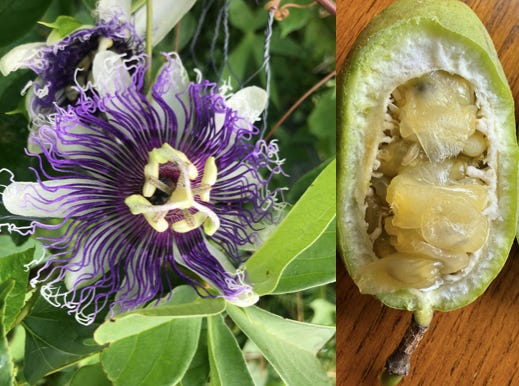
A 4-species hybrid Passiflora seedling with full fruit and self-pollinating ability.
Sweet Potato x I. pandurata
The most unlikely hybridization experiment of 2025 was definitely sweet potato x man-root (Ipomoea batatas x pandurata). Based on all published studies on sweet potato hybridization, there should have been zero seedlings resulting from this cross, and yet it worked great. All I did was place a true sweet potato seedling (grown from an actual seed, not a root tuber) next to a large spontaneously-growing Ipomoea pandurata vine. Besides germinating and cultivating the sweet potato seedling for a couple months, I simply brought the potted seedling over to a nearby yard with I. pandurata, and occasionally stopped by to water it. Not only did the cross work, virtually every flower formed seed (but only when both species were flowering together). A dozen or so hybrids from this cross are currently flowering and twining all over the place in the basement grow room. They have a high degree of pollen sterility, but I’m not going to conclude they’re fully pollen sterile until I get them out in the sunshine with less aphids and more bumblebees. One has red skin with white flesh and another has tan skin with orange flesh. The others I will wait for them to bulk up their roots more. The leaves are more leathery than sweet potatoes, and the vines are more fibrous. You can tell when you take cuttings that they have more fiber in the stems. I haven’t tasted the tubers yet because they’re still small, but the leaves taste fine, similar to sweet potato. With time there will be more data about root quality, fertility, freeze-tolerance and so forth. I’ll be sharing slips of these with a few people for the 2026 season to see how they do in different conditions.
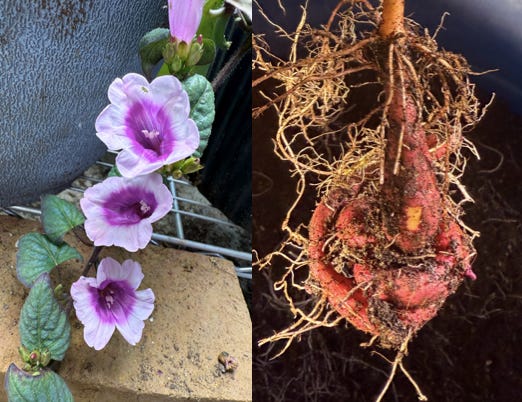
Here is the only seedling so far that I dug out and inspected the roots. Note the leathery leaves, hinting at drought tolerant traits from I. pandurata.
Goji
One crop I’ve worked with, but that got put on pause in 2025, is interspecific Lycium hybrids. Luckily, Michael Longfield of Interwoven Permaculture was able to make further progress on this front. The three species goji seedlings (“triple” goji) in my yard are in too much shade and not fruiting, so I sent one off to Michael. Around the same time, he started growing a cultivar which is the pinnacle of Chinese goji breeding called “Gigantic Ningxia.” He crossed the triple hybrid goji with the pollen of the gigantic goji. The basic idea is to combine large fruit with the more vigorous, humidity/mildew tolerant nature of L. chinense. With some black goji genetics in the background, seedlings with large purple fruit and juicy texture can be selected. Additionally, large leaf sizes could show up as well for a dual purpose leaf/fruit crop.
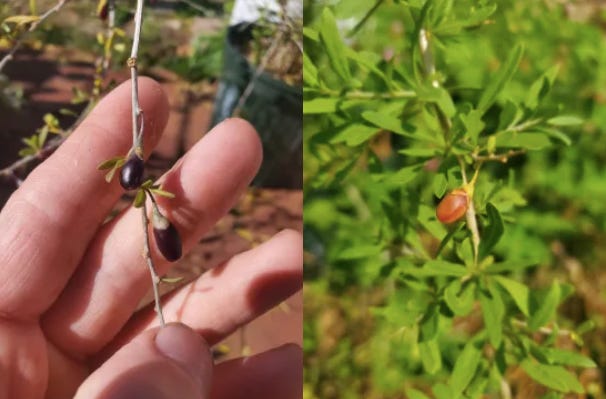
Photos of one of the “triple goji” seedlings, courtesy of Interwoven Permaculture. The color changes with ripeness, which is a trait shared by the maternal parent of this seedling called “Stardust.” The pollen parent of this group of seedlings was Lycium chinense “large leaf.”
Some thoughts
A highlight from these 2025 season crosses is that parental selection is very important. Certain parents are able to promote the fertility of distant hybrids and essentially act as “super-parents.” With other parents, its about another special quality such as insect resistance or fruit size, which can be equally important factors in determining the usefulness of a crop. Another salient point, seen in the sweet potato x pandurata cross, is that you sometimes want to strategically limit diversity in order to expand it. If I had placed several sweet potato seedlings next to the I. pandurata vine, its highly likely that no hybrids would’ve been obtained because of the competitive advantage of the sweet potato pollen. All of the progress in a short amount of time on these various projects brings up the need for more growers to further develop these lines.
This is so exiting!
Fantastic work on multiple fronts! Bravo! You are making breakthroughs with species I had to put aside since my conditions weren't quite suitable.