
Grafted realities
The evolved context of Ivan Michurin

One of my main inspirations for learning about plant breeding is Ivan Michurin (1855-1935). Several years ago I was reading one of the late Mae Wan-Ho’s Institute of Science and Society articles, and it mentioned Michurin’s work transferring traits via grafting and adapting fruit trees to extreme cold. He was called the Russian Luther Burbank, and as contemporaries they both released hundreds of new cultivars and made progress with distant hybridization. They also both believed that traits could under certain conditions be transmitted through grafting. Burbank wrote about transmitting leaf color from a purple leaf plum rootstock into the seedlings of the green leaved scion. Nearly 100 years later that same experiment was replicated and confirmed by Chinese researchers (see here). In the context of the Mae Wan-Ho article, it was relating Michurin’s work to the discussion of genome fluidity and perhaps a kind of “natural genetic engineering.”
I decided to read Michurin’s book ‘Selected Works.’ After getting past a few pages of propaganda in the introduction, I found it an earnest account of his experiences over the decades. One reason you get this impression is that there seems to be a kind intuitive logic to what he’s saying. Caveat: what you see written about in the cold war biology debates as “Michurinism” is bit of a different beast, and was developed in large part through the writings and edicts of Trofim Lysenko. You can get a feel for the difference between Michurin and Michurinism by doing image searches of Michurin and Lysenko, you’ll see what I mean. One big difference is that Michurin did not deny the existence of discrete units of heredity and Lysenko did. This is part of the debate that went on at the time before the existence of DNA had been demonstrated. While the Soviet government did much to support Michurin later in his life, it was only about the last decade of his life that the Soviet Union existed. Most of his time doing horticulture and breeding he was poor and his work unrecognized. It was under these relatively meagre conditions that he gained his experience, developing his principles, methods, and new cultivars.
One of the things that makes intuitive sense as Michurin fleshes it out is the concept of plasticity. He uses this term repeatedly throughout his writings, and talks about a spectrum from plasticity to stability. The most stable varieties have the greatest potency of hereditary force, while the most plastic young seedlings can be imprinted and trained in novel ways (such as the ability to root from cuttings or adapt to a different climate). On the highly stable end of the spectrum would be a wild perennial plant that has been growing vegetatively for a long time, and of course with a relatively larger amount of biomass compared to a young seedling. On the other extreme would be a young seedling, even more so a hybrid seedling. And even more plasticity when it’s a distant hybrid. Crossing plants from different climates will yield more plastic seedlings than crossing localized ones. All of these constitute various types of stresses for an organism. Michurin realized that you can layer additional stresses on by grafting and pruning these plastic young hybrid seedlings. Likewise, an increasing distance in the rootstock/scion relationship is another form of stress. It was the technique of mentor grafting based on these observations that allowed Michurin to answer the question of the conditions under which graft induced variation occurs.
Michurin worked with a wide variety of plants in his life, and one time even worked on tea in the relatively warm climate of Sochi. But later he made it his focus to expand the range of cultivated fruit trees into the colder parts of the country. Michurin developed many novel methods to aid hybridization including mentor pollination, preliminary vegetative approximation, use of a bridge species, mentor grafting, and intraspecific crossing prior to interspecific and intergeneric crossing. Less well known is that he worked as an electrician and experimented with the impacts of electromagnetism on plants, and found in particular that “the exposure of pollen and female generative organs to static electricity and other biophysical factors increased the efficiency of distant crosses” (source). What’s interesting is that now approaching an 100 years since Michurin passed, despite his ideas having largely been confirmed in the scientific literature, his work is not widely known by plant breeders today outside of certain areas. Compare this to Mendel, who everyone learns about in the first semester of biology. It’s interesting to compare Mendel with Michurin, as they have totally different emphases: annuals vs. perennials, inbred vs hybrid, qualitative vs. quantitative traits, transmissional vs. developmental genetics (see more).
One of the most common cultivars of Michurin’s in the US is his xSorboaronia mitschurunii which has been renamed and is grown at scale for “Aronia” berry production. His arguta kiwi “Ananasnaya Michurina” (usually called Anna) is still considered one of the best cultivars of the species and is also widely grown. In Europe there are many more of his cultivars available. For more information on his cultivars and ideas about breeding and selection see this paper from 2015 in the Latvian Academy of Sciences. Beyond the cultivars that Michurin himself released, he inspired many researchers to attempt distant hybridization with novel methods. For example, the first Diospyros kaki x virginiana (asian persimmon x American persimmon) was obtained in Ukraine and said to have been made possible by grafting prior to crossing. Many new cold tolerant, large fruited persimmon cultivars were descended from this original cross (though later new F1s were made via embryo rescue). Much of the work inspired by Michurin’s principles and methods is not well known and is part of what I will explore in future posts.
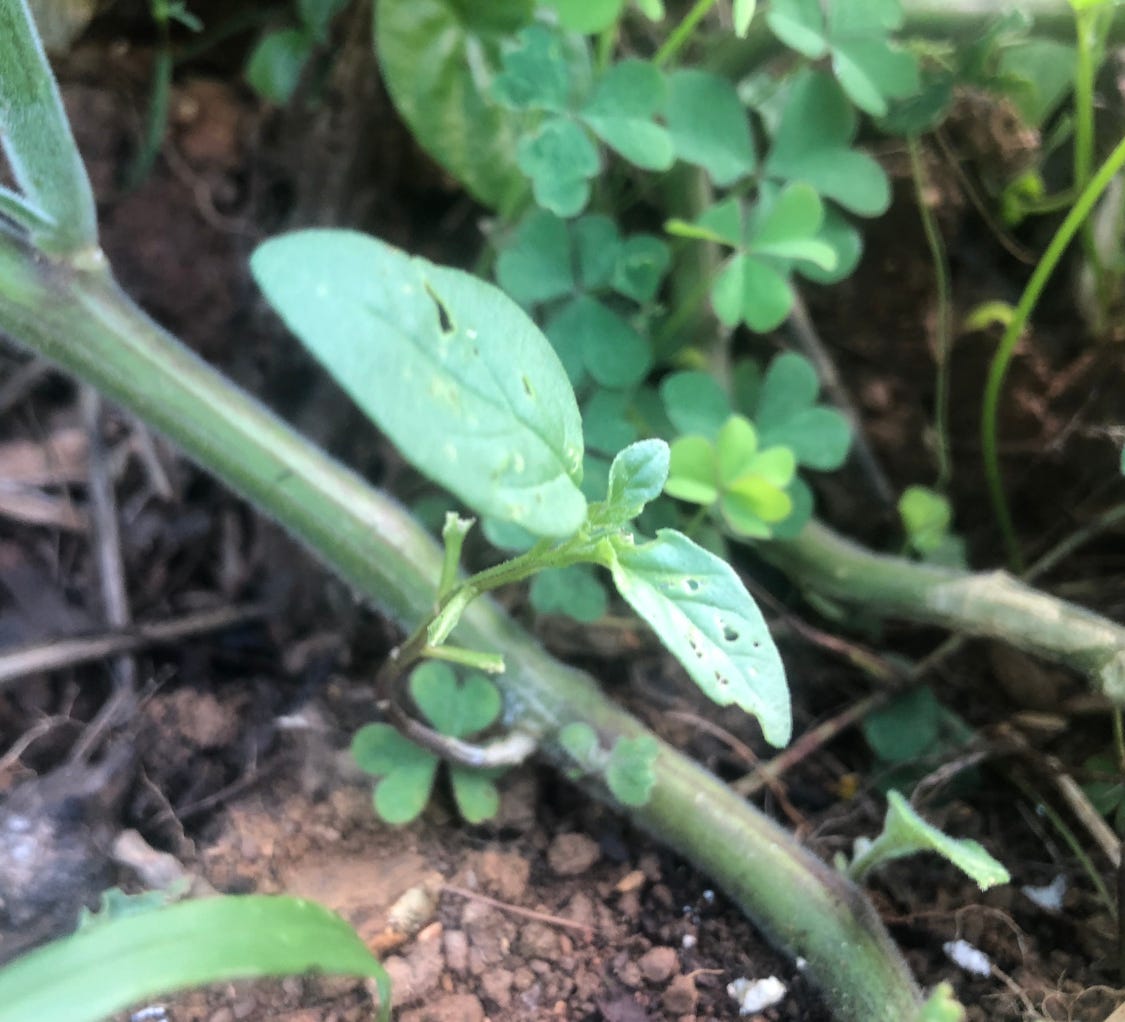
Photo of a Physalis longifolia scion growing on a horizontally bent Physalis peruviana.
Niektóre cechy podkładki widać w zaszczepionej na niej roślinie, ale jest to raczej efekt tego, że oba komponenty stanowią 1 organizm i substancje z korzeni są też np. w owocach. Nie wierzę w to, że podkładka może zmienić genom zrazu, ale Winkler opisywał szczególne typy chimer - nie perykrinalne, nie meryklinarne, nie sektorialne, ale takie które mają jednolity charakter (pośredni między obu komponentami). Nazywał je burdonami.
...poza tym oczywiście szczepienie i inne zabiegi mogą pomóc przy krzyżowaniu międzygatunkowym, (ale oczywiście drogą generatywną). My także bardzo cenimy Miczurina. Widać, że kochał swoją pracę i miał do niej naprawdę "rękę". Można się od niego wiele nauczyć. ...szkoda tylko, że trudno na wszystko znaleźć czas, bo trzeba jakoś "przetrwać". ...myślę, że wielu pasjonatów hodowli mieszańców to rozumie
As I became fascinated by Michurin, I felt compelled to build a collection of his plant material. Its delightful learning new plants that I already have that he was responsible for, such as 'Anna'. Its particularly amazing to hear the first diospyros kaki x diosypros virginiana hybrid (rosseyanka) was made possible by vegetative approximation... mind blown.